

Why Fiberglass Beats Vinyl for Window Replacement in Colorado
If you’re replacing windows in Colorado, there’s one material that outperforms the rest: fiberglass. At Gravina’s Window Center of Littleton®, we’ve been Colorado’s trusted window replacement specialists since 1973, and have focused exclusively on fiberglass window replacement since 2003. We’re proud to offer Infinity by Marvin® fiberglass windows, designed to handle Colorado’s extreme weather where vinyl fails.
- Colorado-Tested Durability: Vinyl can warp, bow, and fail under Colorado’s harsh UV exposure and rapid temperature swings. Infinity’s Ultrex® fiberglass is 8x stronger and far more dimensionally stable than vinyl, meaning no warping, cracking, or seal failures.
- Energy Efficiency that Pays Off: Most homes lose 40% of their heating energy and 50% of their cooling energy through outdated windows. Infinity from Marvin fiberglass windows are engineered for performance, with multiple panes, Low-E coatings, and weather-tight seals, to cut energy costs by up to 50%.
- Low Maintenance, High Style: Unlike vinyl, which fades and becomes brittle, fiberglass holds its finish and resists aging. Infinity windows can even be painted for ultimate design flexibility. No chipping, peeling, or scraping required, just timeless curb appeal.
- Environmentally Responsible Choice: Fiberglass is more sustainable than vinyl, and it’s recyclable. With better energy performance and a longer lifespan, fiberglass is the eco-smart solution for modern homeowners.
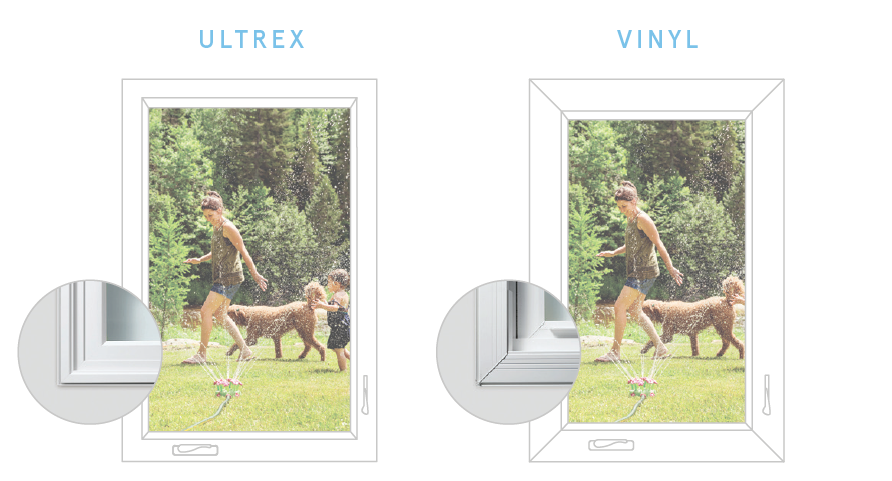
When it comes to window performance in Colorado’s unpredictable climate, not all materials are created equal. That’s why we recommend Ultrex® fiberglass, exclusively used in Infinity by Marvin® windows, over standard vinyl. Ultrex is up to 8x stronger, resists warping and cracking, and outlasts vinyl in every measurable way.
Colorado homeowners replacing windows face a choice that looks simple on the surface: fiberglass or vinyl? The price difference is real. But so is the performance gap, and in a state that cycles between -20°F winters, 300+ annual days of UV exposure, and afternoon hailstorms, that gap isn’t academic. It shows up in your energy bills, your window warranty, and whether your frames are still square in fifteen years.
This guide covers what the data actually says about fiberglass versus vinyl, and why, after more than 50 years of window replacement experience in Denver, we recommend Ultrex® fiberglass every time.
Is Fiberglass Stronger Than Vinyl for Windows?
Yes, by a significant margin. Ultrex® fiberglass, the proprietary material used in Infinity from Marvin® windows, is 8 times stronger than vinyl on a weight-for-weight basis. That strength translates directly into structural performance: fiberglass frames hold their shape under load, resist racking, and maintain tight seals over decades of thermal cycling.
Vinyl is made from polyvinyl chloride (PVC), a material that expands and contracts roughly 8 times as much as glass when temperatures shift. In Colorado’s climate, where a single day can swing 40°F, that movement is constant. Over time, it loosens corners, degrades weatherstripping, and compromises the seals of insulated glass units. Once a seal fails, the insulating gas escapes, and the window never recovers its thermal performance.
Fiberglass expands and contracts at nearly the same rate as glass itself. That compatibility is why fiberglass-framed windows maintain their seals, their squareness, and their performance ratings far longer than vinyl alternatives.
How Does Colorado’s Climate Affect Vinyl Windows?
Colorado’s climate is among the most demanding in the country, and vinyl was not engineered for it.
UV exposure is the first problem. At Denver’s elevation (5,280 feet), UV radiation is approximately 25% more intense than at sea level. Even vinyl windows with color running through the material become brittle over time under sustained UV exposure, developing microcracks that compromise structural integrity.

Infinity’s Ultrex® fiberglass uses the same acrylic cap technology adopted by the auto industry in the mid-1940s, when manufacturers switched from colored glass taillights to colored acrylic. Look at any car from that era today: the steel body has long since rusted, but the acrylic taillights are still holding their color and clarity 80 years later. That’s the material protecting your Ultrex® fiberglass frames, engineered to hold its finish and structural integrity for 40 to 50 years through Colorado’s relentless UV exposure in ways vinyl simply cannot match.
Temperature cycling is the second. Colorado regularly experiences 30 to 50°F temperature swings within a single day, particularly in spring and fall. Vinyl’s high thermal expansion and contraction mean the frame is constantly moving. Corner welds, the weakest point in any vinyl window, absorb this stress first. In cheaper vinyl products, corner failures appear within 5 to 10 years.
Hail is the third. Colorado leads the nation in hail insurance claims. Ultrex® fiberglass has documented impact resistance that vinyl cannot match. It does not dent, crack under impact, or require replacement after moderate hail events, the way vinyl frames sometimes do.
Do Fiberglass Windows Save More Energy Than Vinyl?
In Colorado, yes, and the difference compounds over time.
Both fiberglass and quality vinyl windows can achieve strong U-factor and Solar Heat Gain Coefficient (SHGC) ratings. The performance edge for fiberglass comes from dimensional stability over time. A vinyl window installed at its rated performance today will gradually underperform as frame movement loosens weatherseals and stresses the IGU (insulated glass unit) perimeter. Fiberglass maintains its factory-rated performance because the frame doesn’t move.
Most Colorado homes still lose 40% of their heating energy and up to 50% of their cooling energy through older, single-pane, or degraded windows. Infinity from Marvin fiberglass windows address this with multi-pane glass packages, Low-E coatings tuned for Colorado’s solar gain, and argon gas fills, all sustained by a frame that won’t shift.
A typical Colorado homeowner replacing 10 to 15 windows with high-performance fiberglass can see energy cost reductions of 20 to 40%, depending on what they’re replacing.
How Long Do Fiberglass Windows Last Compared to Vinyl?
Fiberglass windows are engineered for a 40 to 50 year service life under normal conditions. Vinyl windows, depending on quality tier, typically perform reliably for 15 to 25 years before seal failures, frame degradation, or operational issues require attention.
The Infinity by Marvin limited lifetime warranty reflects this: it covers Ultrex® fiberglass frames for as long as you own your home. Most vinyl window warranties cap structural coverage at 10 to 20 years, with seal failure coverage often limited to the same window.
For a Colorado homeowner doing a full window replacement, fiberglass is often a once-in-a-lifetime investment. Vinyl is frequently a twice-in-a-generation replacement.
Is Fiberglass More Expensive Than Vinyl? Is It Worth It?
Yes, fiberglass windows carry a higher upfront cost, typically 15 to 30% more than comparable vinyl at the point of purchase. The relevant question is total cost of ownership.
When you factor in longer service life (30 to 50 years vs. 15 to 25 years for vinyl), sustained energy performance that doesn’t degrade with frame movement, lower maintenance costs, and full paintability for custom finishes, the cost-per-year of ownership typically favors fiberglass within 10 to 12 years of installation in Colorado conditions.
Vinyl windows are not a bad product. They are the right product in certain climates and at certain price points. In Colorado, with its UV intensity, temperature cycling, and elevation, they are the second-best choice.
What Does Fiberglass Window Replacement Cost in Colorado?
Most Colorado homeowners pay between $2,500 and $3,500 per window, installed, for Infinity by Marvin fiberglass windows. A typical whole-home replacement project of 10 to 15 windows runs between $25,000 and $52,000 depending on the variables below.
What drives the cost up:
- Custom or non-standard sizes
- Higher window counts
- Complex installation conditions (rotted framing, stucco exteriors, second-story openings)
- Premium glass packages (triple pane, specialty Low-E coatings)
- Larger window styles (bay, bow, casement combinations)
What keeps the cost down:
- Standard opening sizes that don’t require custom fabrication
- Straightforward installation conditions
- Replacing windows in the same style and configuration as existing openings
Every Gravina’s quote is itemized by window, fully installed, with no asterisks and no “call for pricing.” You’ll know exactly what each window costs before anyone asks you to sign anything. Our consultations are free, no-pressure, and typically take about an hour in your home.
If you’re also comparing window companies alongside materials, see our guide to the best window replacement companies in Colorado to understand what separates installation quality, warranty backing, and long-term accountability.
Ready to see the numbers for your home? Call 303-794-0490 or request a free in-home consultation online.
Why Does Gravina’s Window Center of Littleton Recommend Infinity by Marvin Fiberglass Windows?
Gravina’s Window Center of Littleton® has specialized in fiberglass window replacement since our founding in 1973. We are Colorado’s oldest Infinity by Marvin Diamond Dealer, and one of the three oldest nationally. That’s not a marketing claim. It’s 50+ years of installation data across Colorado homes in every climate zone from Denver proper to the mountain foothills.
The product we install uses Ultrex® fiberglass exclusively. Ultrex is pultruded fiberglass: a manufacturing process that produces consistent, void-free material with verified mechanical properties. It is not the same material as poured or chopped fiberglass composites found in some competitor products. The distinction matters in Colorado’s environment.
We also install every window with W2 employee installation crews, no subcontractors. The window is only as good as the installation. We stand behind both.
Fiberglass vs. Vinyl: Side-by-Side Comparison
| Feature | Ultrex® Fiberglass | Standard Vinyl |
|---|---|---|
| Strength (vs. vinyl) | 8x stronger | Baseline |
| Thermal expansion | Matches glass (near zero movement) | 8x rate of glass |
| UV resistance | Inert; acrylic capping | Becomes brittle |
| Typical service life | 30 to 50 years | 15 to 25 years |
| Paintability | Yes, full exterior paint | Not recommended |
| Warranty (frame) | Lifetime (owner) | Lifetime, typical |
| Colorado performance | Engineered for it | Performs below potential |
| Maintenance | Minimal | Periodic; replacement earlier |
Frequently Asked Questions: Fiberglass vs. Vinyl Windows in Colorado
Are fiberglass windows worth the extra cost in Colorado?
For most Colorado homeowners, yes. The combination of UV intensity, temperature cycling, and altitude accelerates vinyl degradation faster than in lower-elevation, less variable climates. Fiberglass pays back the price premium through sustained energy performance, longer service life, and avoided replacement costs.
Can vinyl windows warp in Colorado?
Yes. Vinyl’s high thermal expansion rate causes frame movement in Colorado’s frequent large-swing temperature cycles. This leads to corner stress, seal compression failure, and in severe cases, visible frame distortion, particularly in west- and south-facing exposures with direct UV load.
What is Ultrex® fiberglass?
Ultrex® is a pultruded fiberglass composite material proprietary to Marvin. It is manufactured by pulling glass fibers through a resin bath and a heated die, producing a consistent, high-strength profile. The process eliminates voids and produces material that is 8x stronger than vinyl, nearly impervious to UV, and dimensionally stable across a wide temperature range.
Does Gravina’s Window Center of Littleton install vinyl windows?
We specialize in Infinity by Marvin fiberglass windows. If your project, budget, or building constraints require a different material, we’ll tell you honestly and help you find the right solution. We won’t sell you something that won’t perform in Colorado.
How do I get a quote for fiberglass window replacement?
Call us at 303-794-0490 or request a free in-home consultation at windowsforyourhome.com/contact-us. Our consultations are no-pressure and include a full design consultation for your home.
Gravina’s Window Center of Littleton® has served the Denver metro area since 1973. We are Colorado’s oldest Infinity by Marvin Dealer with two Denver-area showrooms in Littleton and North Denver. All installations are performed by our own trained, full-time crews, no subcontractors.
Page updated June 2, 2026.
3 Comments
[…] Read the full article at: http://www.windowsforyourhome.com […]
[…] Read the full article at: http://www.windowsforyourhome.com […]
[…] you're thinking of getting new windows, we highly recommend going for Infinity from Marvin instead of vinyl windows. Trust us, you won't regret it. The difference in quality and durability is […]
Recent Posts